There’s something slightly uncomfortable about teaching AI readiness for a living while privately wondering if you’re keeping pace yourself.
I spend most of my working hours helping organisations prepare their people for AI — mapping capability gaps, designing training programmes, coaching leaders through the uncertainty. I know the frameworks. I know the research. I know what good AI adoption looks like in theory.
But earlier this year I decided to find out what it felt like from the other side. Not as a consultant. As a student.
The bootcamp that changed how I think about AI tools
I enrolled in a hands-on Claude Code bootcamp run by BK — his Foundations of Claude Code workshop. Claude Code, if you’re not familiar with it, is Anthropic’s AI coding tool — a CLI (command-line interface) that lets you build and modify software through conversation. You describe what you want. The AI builds it. You review, refine, iterate.
The premise was deceptively simple: start from scratch, build something real, learn by doing. No scaffolding. No safety net. Just a blank project and a tool you’ve never used before.
I came in with zero background in software development. I can write. I can think. I understand systems and strategy. But writing code? That has never been part of my toolkit.
That turned out to be exactly the point.
What “learning from scratch” actually means
The first thing you discover when you start building with Claude Code is that it rewards clarity of thought more than technical knowledge.
Every prompt I gave was essentially a brief. The clearer my thinking, the better the output. The more precisely I could describe the problem, the structure I wanted, the user experience I had in mind — the more useful the result. The vague prompts produced vague results. The specific ones produced something I could actually work with.
This is something I talk about in my workshops all the time. AI tools are amplifiers. They amplify good thinking and they expose unclear thinking. What I hadn’t fully appreciated until I was sitting there at the keyboard was how quickly and honestly that feedback loop operates.
You know within seconds if you’ve been precise. There’s nowhere to hide.
From the old site to the new
Before I get to the launch — here’s what the previous mindscapesg.com looked like:
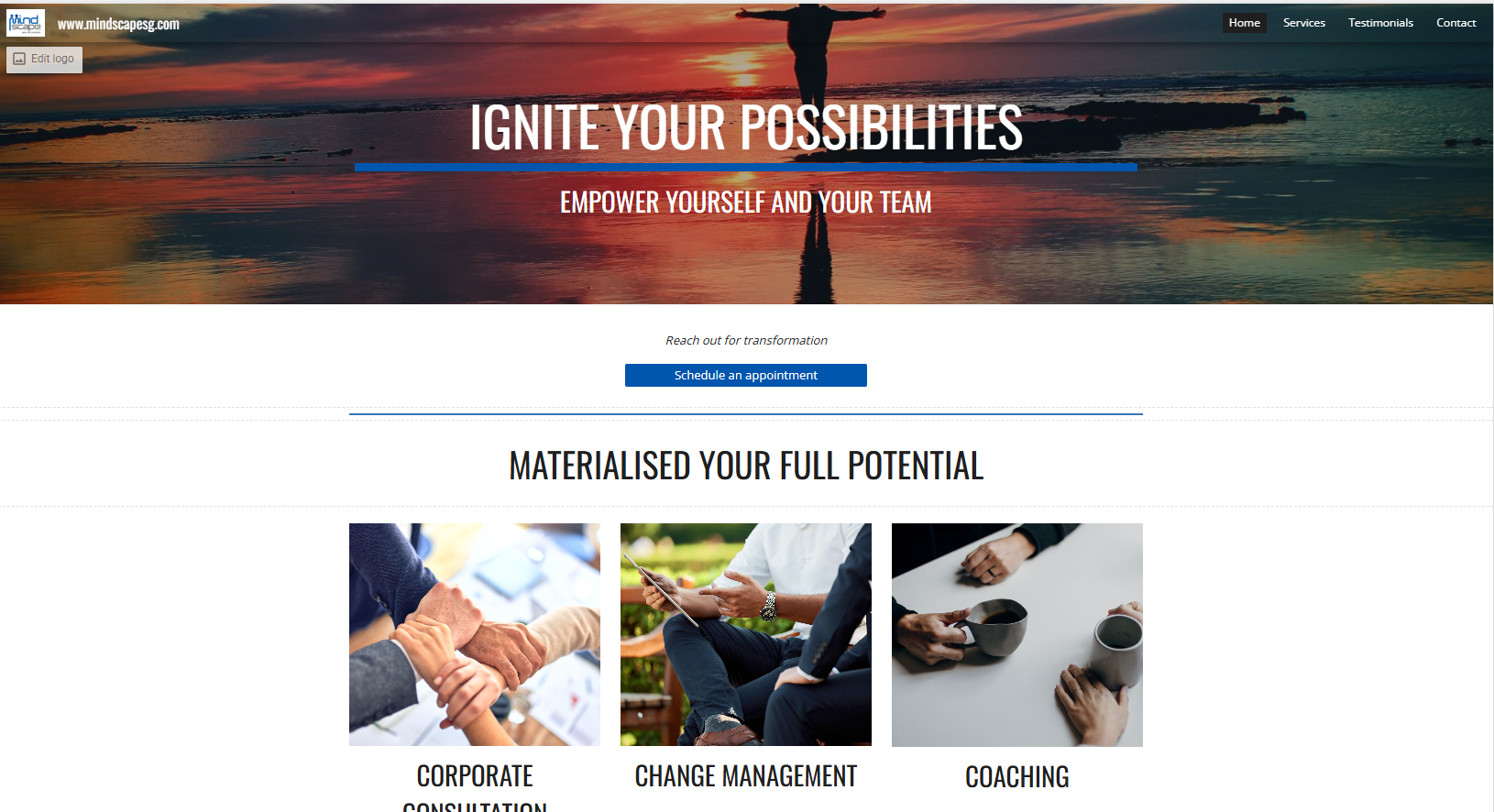
The old site did its job at the time. But it no longer reflected where the practice had evolved. New positioning, new services, a completely different audience — and a platform that couldn’t keep up. The bootcamp gave me the opportunity to rebuild it from scratch, properly.
Launching the site: 27 May 2026
The website you’re reading right now — mindscapesg.com — launched on 27 May 2026. It was built almost entirely through Claude Code, across a series of intensive working sessions.
What that process looked like in practice:
- Defining the structure, content architecture, and user flow as clearly as I could — not as a developer, but as a consultant who knows what the site needs to do
- Translating those requirements into prompts — essentially, writing briefs that Claude Code could act on
- Reviewing the output, identifying gaps, and iterating
- Making deliberate decisions at every step about what to keep, what to refine, and what to discard
The site isn’t a template. Every section — the homepage, the services pages, the blog, the audit pathway, the contact form — reflects decisions that were made explicitly, tested, and revised.
That’s not magic. That’s process.
The two upgrades since launch — and why that matters
Since the site went live, I’ve pushed two further rounds of improvements. As of today, it’s still work in progress.
That phrase — work in progress — used to feel like an apology. It doesn’t anymore.
One of the real shifts that came from this experience is a different relationship with imperfection. The bootcamp approach isn’t “build it perfectly then launch.” It’s “build it well enough to learn from, then improve.” The site that launched on 27 May was good. The site today is better. The site in two weeks will be better still.
Each upgrade has been small but deliberate: a layout refinement here, a content improvement there, a technical fix that makes the experience smoother. What matters isn’t any single change — it’s the discipline of continuous iteration.
This is what I mean when I talk about Stage 4 AI fluency with clients. It’s not the one-time deployment. It’s the ongoing, embedded practice.
What I learned that I couldn’t have learned any other way
A few things stand out:
Domain knowledge is your biggest asset. I couldn’t write the code, but I knew exactly what the site needed to accomplish and for whom. That clarity was more valuable than any technical skill I was missing. Claude Code didn’t replace my expertise — it gave me a way to express it.
Mistakes are data, not failures. I made plenty of wrong calls during the build. Prompts that didn’t produce what I intended. Decisions I had to reverse. Every one of them taught me something about how to think more precisely next time.
The tool is only as good as the operator. Claude Code is genuinely capable. But it works best as a collaborative partner — when you bring a clear point of view, strong judgment, and the willingness to stay in the loop. Passive use produces passive results.
Learning by doing beats learning about doing. I have read extensively about AI tools. I have studied how they work, what they’re good for, where they fall short. None of that prepared me for what I learned in ten hours of building something real. The knowledge gap was never conceptual. It was experiential.
Why this matters beyond the website
I built mindscapesg.com as a practical exercise. But what I walked away with was more than a website.
I now have a lived reference point for every conversation I have with a client about AI adoption. When someone says they’re not technical enough to use AI effectively, I know — from direct experience — that technical ability is not the main constraint. When someone says they’re not sure where to start, I know what it feels like to sit in front of a blank project with a tool you’ve never touched before. When someone talks about the gap between learning AI and using AI, I’ve crossed that gap myself.
The bootcamp with BK gave me that. The continuous improvement work since has deepened it.
This site is my proof of work. And it’s still in progress.
Kelvin Lee is the founder of Mindscape Consulting. He delivers AI adoption and human development training for organisations across Singapore and Southeast Asia. Book an AI Readiness Audit to find out where your team stands — and what it would take to close the gap.